

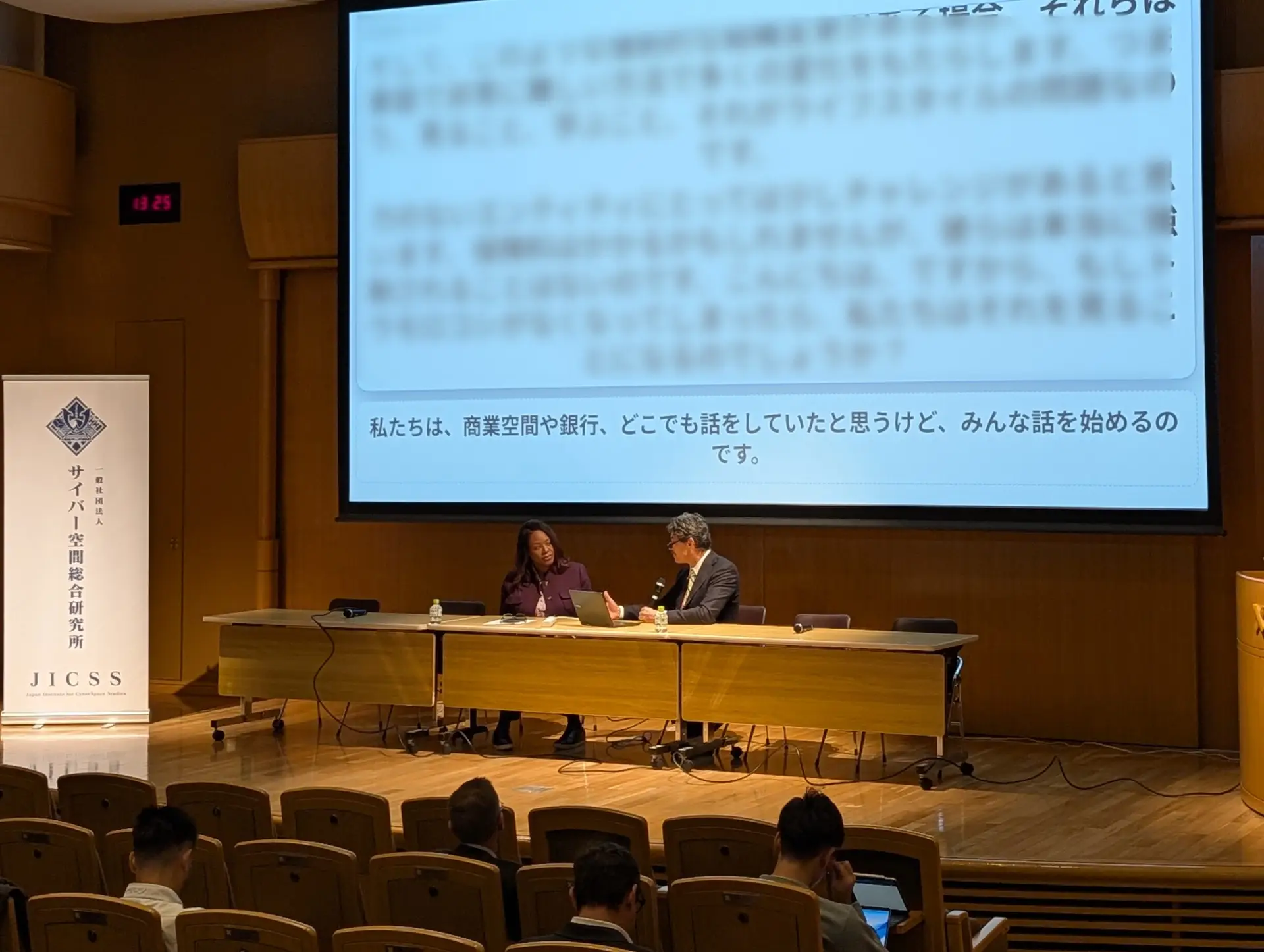
Seminar by Gloria Glaubman”Active Cyber Defense and Japan-US Cooperation”

Date: July 29, 2025
Location: JICSS Headquarters, KR II Ginza Building, Tokyo


Event Overview

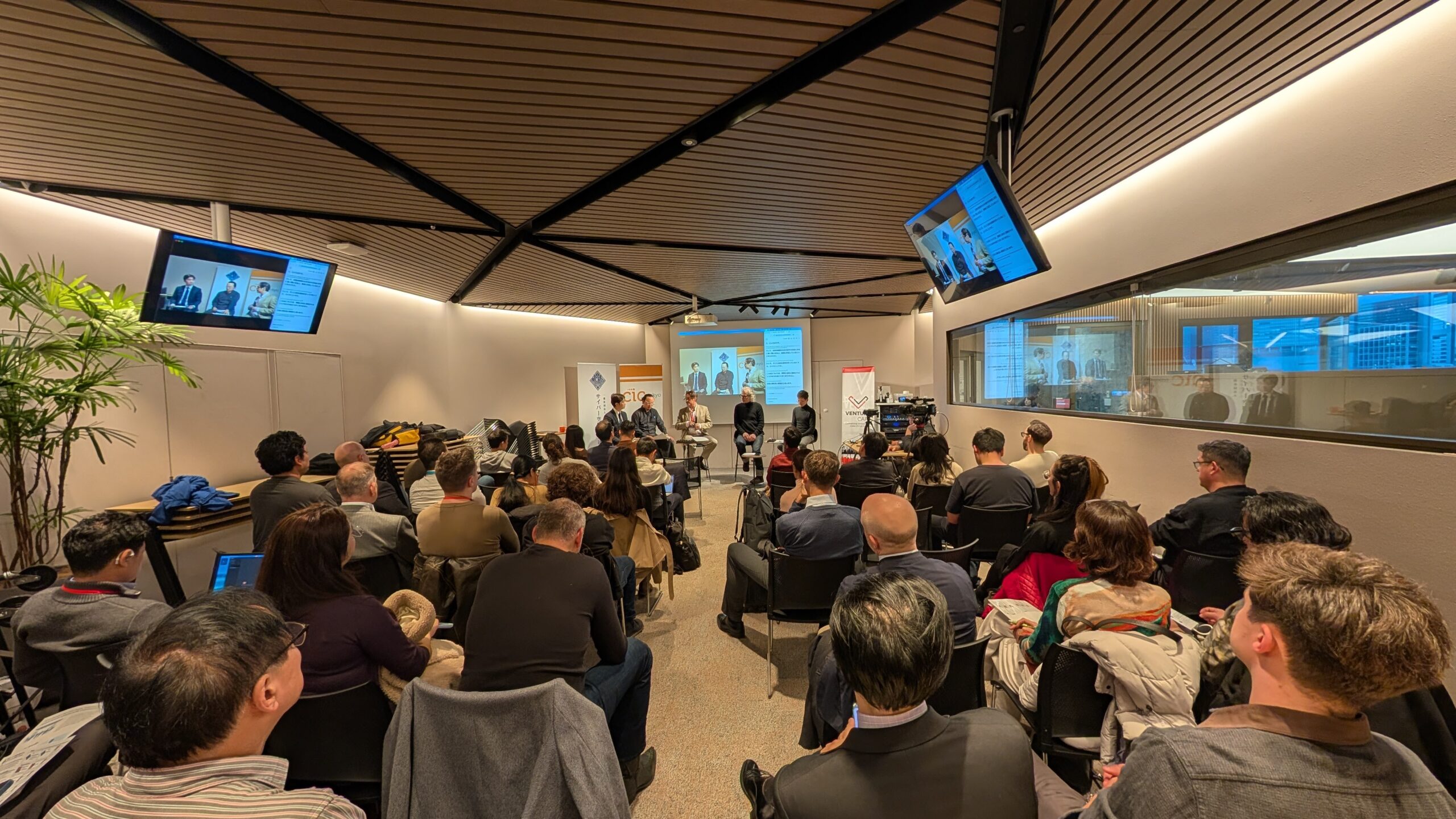
The Japan Institute for Cyberspace Security Studies (JICSS) successfully hosted its Q3 2025 seminar featuring a comprehensive presentation on Japan’s Active Cyber Defense (ACD) framework and opportunities for enhanced Japan-US cybersecurity cooperation. The event was held at JICSS headquarters on July 29, 2025, from 19:00 to 20:50 JST, followed by a networking reception.

The seminar was conducted under Chatham House Rules to encourage frank and open dialogue among participants.

Distinguished Guest Speaker

The seminar featured Ms. Gloria Glaubman, Senior Cyber Adviser at the U.S. Embassy in Japan, as the keynote speaker. Ms. Glaubman was recognized for her pivotal role in revitalizing cybersecurity understanding and fostering bilateral cooperation between Japan and the United States. The seminar marked Ms. Glaubman’s final engagement in her official capacity at the Embassy.

Participants

The seminar brought together a distinguished group of cybersecurity leaders from government, military, industry, and academia, representing both Japanese and international organizations. Participants included representatives from U.S. government agencies, major technology companies, defense contractors, and academic institutions, participating both in-person and online.

Discussion Highlights

Ms. Glaubman delivered an insightful presentation examining the current state of cybersecurity developments in Japan and exploring pathways for strengthened international cooperation. Her presentation drew on extensive experience working with Japanese cybersecurity stakeholders and provided valuable perspectives on the evolving threat landscape.

Major Themes Discussed:

1. Structural Differences in US-Japan Cybersecurity Operations

The discussion highlighted fundamental differences in the operational structures between U.S. and Japanese cybersecurity frameworks. These structural divergences present challenges to seamless bilateral cooperation and information sharing. However, both nations have benefited significantly from shared intelligence and lessons learned through the Five Eyes alliance framework.

2. Japan’s Active Cyber Defense Law

Participants examined Japan’s new ACD legislation, representing a major evolution in the country’s cybersecurity posture. The implementation timeline is projected at 2-3 years, with significant attention required to reconcile differing operational approaches between Japanese and U.S. frameworks, particularly regarding transparency and information sharing protocols.

3. Security Clearance and Classification Challenges

A critical barrier to enhanced cooperation was identified in Japan’s security clearance system, which is not yet fully aligned with Five Eyes standards. This misalignment creates obstacles to intelligence sharing and joint operations. Additionally, trust and coordination issues between different Japanese agencies—including the Ministry of Defense (MOD), National Police Agency (NPA), and the newly established National Cybersecurity Office (NCO)—require attention.

4. Cloud Adoption and Regulatory Constraints

The discussion addressed regulatory barriers to cloud adoption in defense cooperation contexts. Private cloud solutions were suggested as potential workarounds for current regulatory constraints while maintaining necessary security standards.

5. Critical Role of Private Sector Engagement

A consensus emerged that private enterprise involvement in both cybersecurity operations and education will be paramount moving forward. Due to limitations in government resources, knowledge, and capabilities, private sector partnerships will remain a strategic priority for both nations. The development of human capital and workforce capabilities was identified as a critical bottleneck requiring immediate attention.

6. Practical Implementation Challenges

Participants emphasized the need for pragmatic, solution-focused proposals with clear timelines and problem statements. Moving from policy to practice requires actionable frameworks and concrete implementation plans that can be executed within realistic timeframes.

Action Items and Next Steps

Following the seminar, JICSS has identified several concrete action items to advance cybersecurity cooperation and understanding:

  1. White Papers on Private Sector Integration: JICSS will circulate draft white papers to all members for input and feedback, focusing on effective models for private sector involvement in national cybersecurity initiatives.
  2. NCO Organizational Mapping: JICSS will develop and distribute a comprehensive mapping of the National Cybersecurity Office (NCO) structure and agency roles. This resource will clarify relationships with existing government agencies and help stakeholders understand the evolving Japanese cybersecurity landscape, promoting more effective cooperation.
  3. IP Asia Meetings Participation: JICSS will facilitate member participation in the “IP Asia Meetings” held weekly on Mondays by Keio University’s Cyber Civilization Research Center (CCRC). These meetings provide opportunities for enhanced information exchange and robust dialogue on Internet society development.
  4. October 2025 Conference Coordination: JICSS will coordinate participation in the Keio University security conference scheduled for October 2025, facilitating continued dialogue among stakeholders.
  5. Private Intelligence Sharing Mechanism: JICSS will continue its ongoing initiative to develop a private Information Sharing and Analysis Center (ISAC) to enhance threat intelligence sharing between industry participants.
  6. Deep-Dive Discussions: JICSS will organize additional focused discussions on private sector involvement, serving as a bridge between public and private sectors to facilitate effective engagement models.

Key Takeaways

  • Japan’s ACD law represents a significant milestone in the nation’s cybersecurity evolution, though successful implementation will require sustained effort over a 2-3 year timeline
  • Structural and operational differences between U.S. and Japanese approaches necessitate careful coordination and mutual understanding
  • The private sector will play an indispensable role in building Japan’s cyber capabilities and operational capacity
  • Human capital development remains the most critical bottleneck and requires immediate strategic attention
  • Actionable, timeline-driven proposals with clear problem statements are essential for moving from policy to practice
  • As a trusted bridge between government and industry, JICSS is uniquely positioned to facilitate the partnerships necessary for enhanced cybersecurity cooperation

Looking Forward

The seminar underscored JICSS’s mission to foster common understanding of cybersecurity structures and terminology, thereby promoting cooperation and development across sectors and borders. By bringing together diverse stakeholders and facilitating substantive dialogue, JICSS continues to advance its role as a thought leader in cybersecurity policy and practice.

JICSS extends its sincere appreciation to Ms. Gloria Glaubman for her outstanding contributions to Japan-US cybersecurity cooperation and wishes her continued success in her future endeavors.
Share the Post:

Related Posts

Login

Please log in below.

Privacy Policy

The Japan Institute for CyberSpace Studies (hereinafter referred to as "JICSS") has established the following privacy policy (hereinafter referred to as "the Policy") regarding the handling of personal information of users in the services provided on this website (hereinafter referred to as "the Services").

Article 1 (Personal Information)
“Personal information” refers to "personal information" as defined in the Act on the Protection of Personal Information, and includes information about living individuals that can be used to identify specific individuals by name, date of birth, address, telephone number, contact information, and other descriptions, as well as data related to appearance, fingerprints, voiceprints, and health insurance card insurer numbers.

Article 2 (Method of Collecting Personal Information)
When you submit an inquiry form, JICSS will obtain your name and e-mail address.

Article 3 (Purpose of Collection and Use of Personal Information)
The purposes for which JICSS collect and use personal information are as follows

To provide and operate our services
To respond to inquiries from users (including identification)
To send e-mail notifications of new features, updates, campaigns, etc. of the service the user is using, as well as information on other services provided by the Company.
To contact you as necessary for maintenance, important notices, etc.
To identify users who violate the Terms of Use or who attempt to use the service for illegal or unjust purposes, and to refuse their use of the service.
To allow users to view, change, or delete their own registration information, or to view the status of their use of the service.
To bill users for paid services.
For purposes incidental to the above purposes of use

Article 4 (Change of Purpose of Use)
JICSS shall change the purpose of use of personal information only when it is reasonably recognized that the purpose of use is related to the purpose of use before the change.
In the event of a change, JICSS shall notify the User of the changed purpose or publicly announce it on this website in a manner prescribed by JICSS.

Article 5 (Provision of Personal Information to Third Parties)
Except in the following cases, JICSS will not provide personal information to a third party without the prior consent of the user. However, this excludes cases permitted under the Personal Information Protection Law and other laws and regulations.
When it is necessary for the protection of the life, body, or property of an individual and it is difficult to obtain the consent of the individual.
When the provision of personal information is especially necessary for improving public health or promoting the sound growth of children, and it is difficult to obtain the consent of the individual concerned.
When it is necessary to cooperate with a national agency, a local government, or an individual or entity entrusted by either a national agency or local government to execute affairs prescribed by law, and obtaining the consent of the individual is likely to impede the execution of such affairs.
When we have notified or announced the following matters in advance, and when we have notified the Personal Information Protection Committee
The purpose of use includes provision to a third party
Data items to be provided to the third party
Means or method of provision to third parties
Cessation of provision of personal information to third parties at the request of the individual
The method of accepting the request of the person in question
Notwithstanding the provisions of the preceding paragraph, in the following cases, the party to which the relevant information is provided shall not fall under the category of a third party.
(i) When we outsource all or part of the handling of personal information within the scope necessary for the achievement of the purpose of use
When personal information is provided as a result of the succession of business due to a merger or other reasons
When personal information is used jointly with a specific person, and the Company notifies the person in advance or makes the information readily accessible to the person in advance to that effect, the items of personal information jointly used, the scope of joint use, the purpose of use by the person using the information, and the name of the person responsible for managing the personal information Article 6 (Disclosure of Personal Information)

Article 6 (Disclosure of Personal Information)
When requested to disclose personal information by the person in question, JICSS will disclose such information to the person without delay. However, if JICSS decides not to disclose the personal information, it will notify the individual to that effect without delay. A fee of 1,000 yen will be charged for each case of disclosure of personal information.
When there is a risk of harm to the life, body, property, or other rights or interests of the person concerned or a third party
If there is a risk of significant hindrance to the proper conduct of our business
If it violates any other laws or regulations.
Notwithstanding the preceding paragraph, in principle, JICSS will not disclose information other than personal information, such as historical information and characteristic information.

Article 7 (Correction and Deletion of Personal Information)
If the User's personal information held by JICSS is incorrect, the User may request JICSS to correct, add, or delete (hereinafter referred to as "correct, etc.") his/her personal information in accordance with procedures determined by JICSS.
If we deem it necessary to respond to the request from the user as described in the preceding paragraph, we will make the correction, etc. to the relevant personal information without delay.
In the event that JICSS makes corrections, etc. based on the preceding paragraph, or decides not to make such corrections, etc., JICSS will notify the User of such decision without delay.

Article 8 (Suspension of Use of Personal Information)
When we receive a request from a user to stop using or delete (hereinafter referred to as "stop using, etc.") his/her personal information on the grounds that it has been handled beyond the scope of the purpose of use or that it has been obtained by wrongful means, we will conduct the necessary investigation without delay.
If, based on the results of the investigation described in the preceding paragraph, we determine that it is necessary to comply with the request, we will suspend the use of the relevant personal information without delay.
When JICSS suspends the use of personal information in accordance with the preceding paragraph or decides not to suspend the use of personal information, JICSS will notify the user of this decision without delay.
Notwithstanding the preceding two paragraphs, in cases where the suspension of use involves a large amount of cost or it is otherwise difficult to suspend the use of personal information, and alternative measures can be taken to protect the rights and interests of the user, these alternative measures shall be taken.

Article 9 (Changes to Privacy Policy)
The contents of this Privacy Policy may be changed without notice to the User, except as otherwise provided by law or other regulations.
Unless otherwise specified by the Company, the revised Privacy Policy shall take effect from the time it is posted on the Website.

Article 10 (Contact for Inquiries)
Inquiries regarding this policy should be directed to the following contact


E-mail: info@jicss.org

Commercial Disclosure

Legal Name The Japan Institute for CyberSpace Studies (JICSS), also registered as 一般社団法人 サイバー空間総合研究所.

Representative Our operations are led by our Director, Terutaka Kawabata.

Address Our headquarters are located at the Ginza Main Office: 4F Ginza KR II Bldg, 2-15-2 Ginza, Chuo-ku, Tokyo 104-0061, Japan.

Contact Information For inquiries, please contact us via email at info@jicss.org or by phone at +81 3 6281 5152. Our telephone support is generally available during standard business hours (10:00–17:00 JST), excluding weekends and public holidays.

Pricing and Additional Fees Service prices and membership dues are clearly displayed on the respective registration or checkout pages. There are no additional hidden fees for digital services; however, any bank transfer fees or internet connection costs remain the responsibility of the customer.

Payment Methods and Timing We accept payments via Credit Card (processed through Stripe) and Bank Transfer. Credit card payments are processed immediately at the time of purchase. For bank transfers, payment is required within 7 days of the order.

Delivery of Services Digital memberships and access to research materials are provisioned immediately upon successful completion of the payment process.

Cancellations and Refunds Due to the nature of digital content and immediate access to membership benefits, we generally do not offer refunds once a transaction is completed. You may cancel your membership at any time to prevent future billing through your account settings, but previous payments are non-refundable.